Early Life and Academic Formation
Carlie Irsay-Gordon grew up inside a singular American dynasty. Her childhood was shaped by football, business, and inherited responsibility. That environment trained her early in institutional memory and disciplined observation. She did not enter the Colts through novelty. She entered through proximity, continuity, and long apprenticeship.
She studied at Skidmore College, where her reported focus in religious studies offered uncommon intellectual texture. That discipline likely sharpened her sensitivity to narrative, ethics, and human behavior. Such a background can matter in a sports enterprise. Football franchises are not only competitive machines. They are also civic symbols, family legacies, and financial engines.
Her upbringing carried the weight of history. Her father, Jim Irsay, presided over the Colts for decades. Her grandfather, Robert Irsay, anchored the family’s franchise provenance. Her mother, Meg Coyle, and her sisters, Casey Foyt and Kalen Jackson, formed a close kinship network around the organization. The family structure provided continuity, but also expectation.
Apprenticeship Inside the Organization
Carlie’s path was gradual rather than abrupt. She spent years learning the organization from the inside. That kind of immersion cultivates tactical fluency and strategic patience. She worked across multiple departments, including business operations and community functions. She also absorbed the practical language of the league.
This internal training gave her a broad organizational map. She observed how football decisions affect revenue, morale, and public trust. She also saw how fan experience and team performance intertwine. A franchise can fail in the smallest details. It can also succeed through quiet coordination.
Her role at league owners’ meetings added another dimension. Those forums require precision, diplomacy, and stamina. They demand fluency in governance, policy, and collective bargaining logic. She learned how the NFL functions as a federation of competing interests. That experience likely strengthened her administrative reflexes.
By the time she served as vice chair and owner, she had accumulated substantial operational capital. Her leadership was not improvised. It was rehearsed through repetition and institutional exposure. That preparation matters in a league where timing is unforgiving. One mistaken turn can echo for years.
The 2025 Succession
In May 2025, the Colts faced a decisive transition. Jim Irsay died, and the franchise activated its succession plan. Carlie Irsay-Gordon became principal owner and CEO. The change preserved family stewardship while formalizing her authority. It was a generational handoff with deliberate scaffolding.
Succession in a professional sports club is never merely ceremonial. It affects football operations, business oversight, and external credibility. A smooth transfer reduces uncertainty for coaches, players, executives, and sponsors. It also reassures a fan base that craves continuity. The Colts chose stability over spectacle.
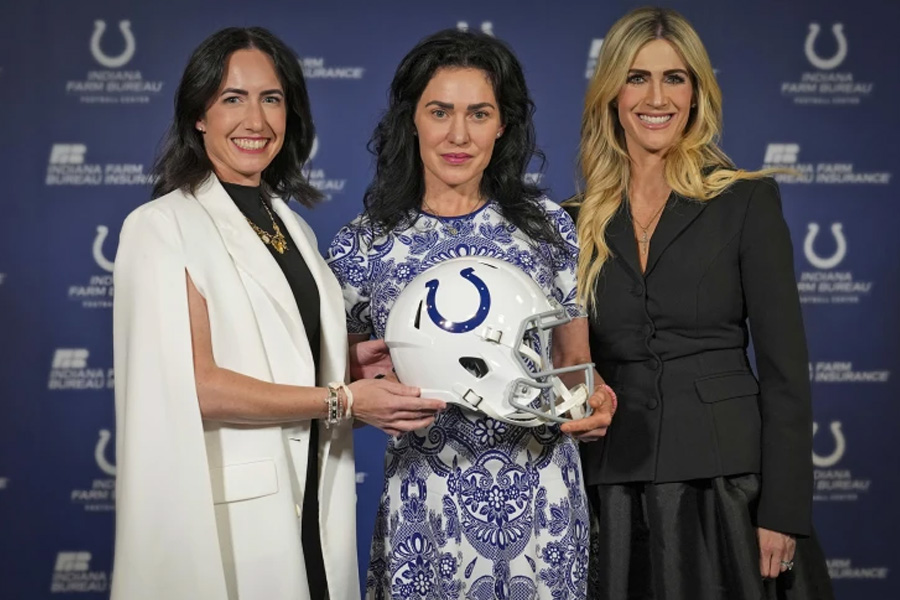
Her sisters assumed elevated roles as well. Casey Foyt entered a more central executive position. Kalen Jackson expanded her responsibilities in brand and community leadership. Kalen also guided the Colts Foundation. The arrangement resembles a corporate phalanx more than a solitary throne. Each sister occupies a distinct but interconnected lane.
This model has practical advantages. It distributes authority without dissolving accountability. It allows specialized stewardship in different domains. It also preserves the family identity that has long defined the franchise. The result is continuity with structural sophistication.
Family Legacy and Organizational Identity
The Colts are deeply intertwined with the Irsay lineage. That legacy stretches across multiple generations. Robert Irsay acquired the franchise and established its familial trajectory. Jim Irsay then carried the team through decades of change. Carlie now represents the next custodial chapter.
Family ownership can provoke scrutiny, yet it also produces coherence. Decisions may emerge from long memory rather than short-term opportunism. That can be a stabilizing force in volatile environments. In Indianapolis, the family’s imprint is visible in leadership style and public posture. The emphasis leans toward stewardship rather than theatricality.
That stewardship also extends beyond the front office. The Colts have long pursued community engagement and civic partnership. Those commitments matter in a city that regards the team as a regional emblem. A franchise’s identity includes wins and losses. It also includes philanthropy, education, and civic trust.
The family arrangement offers another benefit. It allows leadership to remain embedded in institutional culture. Outsiders often need years to learn what insiders already know. Carlie’s ascent from within reduced that learning curve. She inherited not only a title, but an operational vocabulary.
Business Discipline and Community Obligation
Carlie’s leadership style appears rooted in precision and steadiness. She seems to value clear accountability and practical coordination. That posture is useful in modern sports ownership. Teams now operate across analytics, media, facility management, and social impact. Each zone requires exacting attention.
The Colts function within a complex economic system. Franchise valuation, revenue sharing, broadcast expectations, and stadium economics all shape strategic decisions. Recent estimates place the Colts near $5.8 billion in value. That figure is substantial, yet it also implies responsibility. Wealth alone cannot produce competitive advantage.
The franchise must convert value into performance. That means investing in infrastructure, personnel, and culture. It also means supporting football operations without neglecting community duties. Carlie’s approach appears to balance those demands. She occupies both the boardroom and the civic sphere.
Below is a compact snapshot of the franchise context.
| Metric | Approximate Figure | Relevance |
|---|---|---|
| Colts franchise valuation | $5.8 billion | Illustrates organizational scale |
| NFL clubs | 32 | Frames competitive governance |
| Succession year | 2025 | Marks formal leadership transition |
| Family executives | 3 sisters | Shows distributed stewardship |
These numbers reveal more than scale. They reveal the burden of managing a major American institution. Every decision influences the field and the city. Every public move reflects on the family name. That dual pressure demands composure.
Leadership Style and Public Presence
Carlie maintains a relatively restrained public profile. That restraint is not passivity. It is a strategic posture. She appears when organizational interests require her presence. Otherwise, she lets the work speak first. In a hypervisible league, discretion can be a formidable asset.
Her approach seems methodical rather than flamboyant. She values structure, preparation, and continuity. Those traits resonate in football, where systems often outlast personalities. Coaches can change quickly. Owners who understand process can steady the wider enterprise. That steadiness supports long-term planning.
She also embodies a modern ownership paradox. She is both heir and operator. She inherits a legacy, yet she must also earn legitimacy. That legitimacy comes through governance, judgment, and visible competence. Her extended tenure inside the Colts has already provided much of that grounding. Experience becomes authority when it is widely recognized.
The league environment intensifies these demands. Owners must navigate media scrutiny, labor dynamics, and shifting consumer habits. Sports betting, digital distribution, and fan monetization add new layers of complexity. A measured owner can respond without overreacting. Carlie’s demeanor suggests that kind of equanimity.
Timeline of Notable Milestones
| Period | Milestone | Significance |
|---|---|---|
| Early 2000s | Deeper involvement across Colts departments | Built operational literacy |
| Pre 2025 | Vice chair and owner duties | Expanded influence inside the franchise |
| Pre 2025 | Representation at owners meetings | Gained league governance experience |
| May 2025 | Jim Irsay dies | Triggers succession plan |
| May to June 2025 | Carlie becomes principal owner and CEO | Formalizes top leadership role |
| 2025 onward | Sisters assume elevated roles | Reinforces family continuity |
This timeline shows a layered ascent. It was not a sudden elevation. It was a cumulative process shaped by long exposure and deliberate preparation. That is often how durable leadership emerges. It is rarely theatrical. It is usually accretive.
The sequence also underscores the family’s planning. Succession was not improvised in crisis. It appears to have been organized in advance. That foresight protects institutional continuity. It also reduces volatility for employees and supporters.
Key Takeaways
Carlie Irsay-Gordon represents continuity shaped by preparation. Her ascent reflects years of internal learning, not symbolic inheritance alone. She entered the top role already fluent in the club’s culture. That fluency is a competitive advantage.
Her leadership joins business rigor with civic responsibility. The Colts remain an NFL franchise, but they also function as a community institution. She appears committed to both dimensions. That balance may define her tenure as much as any on-field result.
The family structure around her strengthens that mission. Casey Foyt, Kalen Jackson, and Carlie form a coordinated leadership triad. Each sister occupies a distinct strategic sphere. Together, they preserve the Irsay legacy while adapting it to modern conditions.
The 2025 transition marked more than a personnel change. It signaled a carefully managed succession across ownership, executive control, and public identity. The Colts chose continuity, preparation, and internal expertise. In a league built on pressure, that can be a rare form of strength.